Email marketing shouldn’t be about sending the same message to everyone and waiting for the opens to come in. Increasingly, it is about earning the right to be in someone's inbox in the first place.
Since mailbox providers are continuously raising the standards for senders, email authentication, engagement, spam complaints, unsubscribe processes, and list quality are all things that marketers have to take into consideration. Technical concepts such as SPF, DKIM, and DMARC also directly impact marketing performance.
Another thing is that recipients are becoming more selective. People don't want more emails; they want better messaging. So your goal should no longer simply be to grow a database or maximize campaign clicks. The goal is to build a healthy, engaged audience and become a welcome presence in their inbox.
In this article, we'll review some often-overlooked but important aspects of email marketing that will help you reach your subscribers’ inboxes and connect with them in a way that keeps them engaged.
Gmail is raising the bar: email authentication matters
First and foremost – deliverability is becoming a marketing responsibility.
Authentication standards such as SPF, DKIM, and DMARC, along with domain alignment, spam rates, and easy one-click unsubscribe, are no longer technical details that marketers can leave entirely to their IT or CRM teams. They directly influence whether campaigns have a chance of reaching the people they were intended for.
This matters because the most beautifully designed campaign doesn’t do much if it lands in spam – or never reaches the inbox at all.
Modern email marketing therefore requires marketers to understand the health of their sending infrastructure:
- Are emails properly authenticated?
- Is the sending domain aligned?
- Are recipients engaging with messages?
- Are spam complaints increasing?
- Can people unsubscribe easily? (more about this point later)
These questions are now part of campaign performance. In other words, deliverability is not separate from marketing. Deliverability is marketing.
Gmail’s rules are a clear sign of where email marketing is heading. Authentication is no longer optional: emails sent to Gmail users must pass basic authentication checks, with SPF and DKIM playing central roles. For marketers, this means deliverability starts long before you press “send” – it starts with making sure your emails are trusted in the first place.
For a deeper look at Gmail’s email authentication requirements, see Smaily’s article: No More Unauthenticated Emails! Gmail Strengthens Email Security.
A bigger list isn't always better: make list quality the priority
For years, list growth has been one of the most celebrated signals in email marketing. More subscribers meant more potential customers. Bigger databases looked impressive on dashboards. Lead-generation campaigns were often judged by how many new contacts they added.
But a large database isn't necessarily a beneficial one.
Imagine having 100,000 subscribers, but a significant percentage haven't opened, clicked, or interacted with your emails for months. On paper, the audience is huge. In reality, a growing share of those contacts may no longer be interested in hearing from you.
Carrying a large number of inactive contacts will come at a cost. They can distort performance metrics, make it harder to understand how your engaged audience is responding, and potentially affect the overall health of your email program.
A smaller, highly engaged audience can be far more valuable. That means marketers should start asking different questions.
Instead of asking, “How many people are on our list?”, ask:
- How many people actively engage with our emails?
- Which subscribers are becoming less engaged?
- What content brings people back?
- Who should we try to re-engage?
- Who has simply stopped wanting to hear from us?
Sometimes the smartest way to improve an email database is not to add more people, but to remove the people who no longer want to be there.
That might mean creating re-engagement campaigns for cold subscribers and, when those efforts fail, allowing inactive contacts to leave.
Make unsubscribing part of your marketing strategy
Indeed, every unsubscribe can feel like a lost opportunity, so this might seem like a questionable point. But trying to prevent people from leaving at all costs can create a much bigger problem: unhappy subscribers who stay on the list, ignore your messages, or mark them as spam.
An unsubscribe is not necessarily a marketing failure. Sometimes it is simply useful information.
Making the process easy and transparent shows respect for the recipient. It also helps maintain a healthier database and gives marketers an opportunity to learn.
Also, instead of treating the unsubscribe page as the end of the relationship, you can use it as a feedback moment.
Give people options such as:
- receiving emails less frequently;
- choosing specific content categories;
- receiving only important updates;
- changing their email preferences;
- or unsubscribing completely.
With this, you give people a choice, show them that you tailor content by thinking about their needs and interests, and will surely avoid losing some valuable contacts.
And even when someone still unsubscribes, you can learn from it. Their reason can reveal problems with frequency, content, relevance, or expectations. It can also help you understand what kind of audience you’re really building, who resonates with your messages, and who it doesn’t.
Write for a person, not a database
Brands naturally talk about themselves: We launched, we offer, our product, our features, our company… But subscribers actually care about what they get out of it.
A good email should therefore feel less like a company announcement and more like something written for a real person.
Instead of focusing on what the brand wants to say, ask:
- Why should the subscriber care?
- What problem does this solve for them?
- What will they get from reading this?
This shift can be surprisingly simple:
- “We’ve added three new features” becomes “Here are three ways to make your workflow easier.”
- “Our autumn collection has arrived” becomes “Find something to stylishly keep you warm this autumn.”
The difference is small, but the perspective changes completely. When subscribers can immediately see the value for themselves, the email becomes more relevant, and relevance is what keeps people subscribing and reading.
Stop focusing only on open rates
Open rates are one of the most familiar email marketing metrics, but they’re not necessarily the most valuable one to chase.
For one thing, an open doesn’t tell you what happened after someone opened the email. A subscriber might open it, glance at it for two seconds, and move on, while another might not register as an “open” at all but still read the email and take action.
There are also technical limitations. Traditionally, an email open has been tracked when a tiny image or tracking pixel loads. Subscribers who block images may therefore be missed. On top of that, privacy features such as Apple Mail Privacy Protection can make open data less precise by preventing marketers from knowing whether and when a person actually opened an email.
That doesn’t mean open rates are useless. They can still help you spot patterns and identify potential problems. But instead of asking, “How do we get more opens?”, it’s often more useful to ask, “What is happening after the email is opened?”
Look at open rates alongside clicks, conversions, unsubscribes, and other actions that actually matter to your campaign.
Here’s a helpful table to give you a quick overview of what different metrics and combinations might reveal (and what you could consider doing about them):
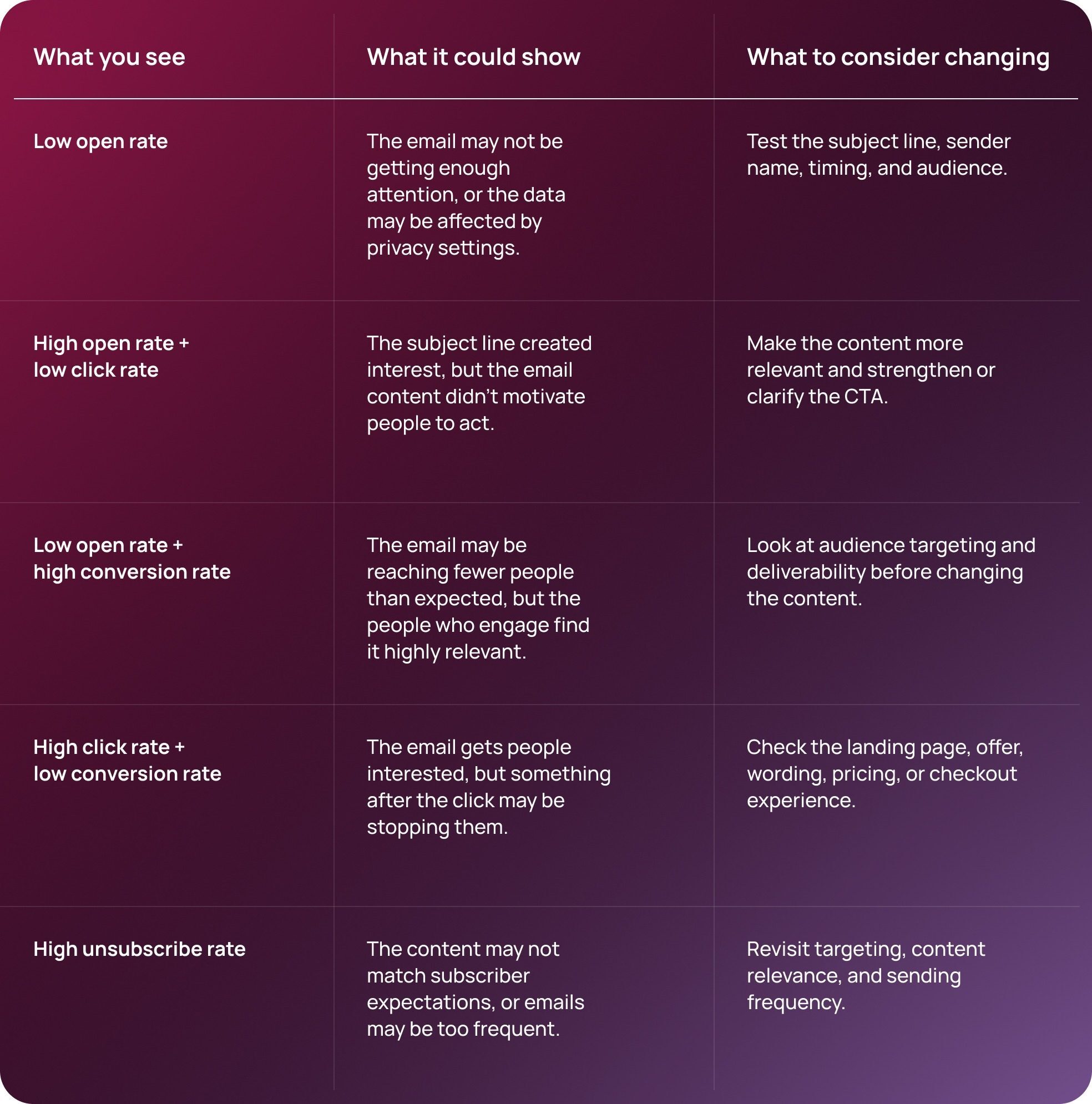
The point isn’t to ignore open rates. It’s to put them in context. A high open rate might look good in a report, but if nobody clicks, signs up, buys, or takes the intended action, what has the email really achieved?
Learn about the most important email marketing metrics here: From Bounces to Opens: What Do My Email Marketing Metrics Show”
Build an inbox experience, not just individual campaigns
Perhaps the biggest shift is to stop thinking about email as a collection of separate campaigns. Your audience doesn't experience your emails that way – they experience them as a whole.
They remember whether your emails are consistently useful or consistently annoying. They notice whether you send three messages in a day and then disappear for a month. They learn what your subject lines usually mean. They develop expectations around your frequency, tone, and content.
In other words, your brand creates an inbox experience. That experience should be intentional.
When it comes to marketing for small businesses in particular, effective strategies don’t require sending more emails or creating complex campaigns. Instead, it's about establishing a simple, sustainable rhythm that you can maintain, ensuring that every email feels purposeful.
Create predictable rhythms. Establish recognizable content categories. Give subscribers a reason to look forward to your emails, and make it clear what kind of value they can expect from you.
Maybe the month’s first Tuesday is for practical advice. The second Friday, your subscribers could wait for curated insights. Product emails arrive only when there is something genuinely relevant to announce. The exact rhythm doesn't matter as much as the expectation.
When subscribers understand what your emails are for, they can decide whether they want them – and that clarity builds trust.
The new definition of email marketing success
Taken together, these changes point towards a different philosophy of email marketing.
Success isn't simply about acquiring more subscribers, sending more campaigns, or generating more clicks. It is about building a healthy relationship between your brand and the people in your mailing list.
The common thread is trust:
- Mailbox providers need to trust that you are a legitimate sender.
- Subscribers need to trust that your emails are worth opening.
- And marketers need to trust the data their audience gives them through engagement and feedback.
Conclusion: Think beyond the send and listen to your audience
Email marketing success isn’t about having the biggest list, the highest open rate, or the most clicks. It’s about building an audience that wants to hear from you and creating emails that are useful, relevant, and worth their time.
Focus on the things that build that relationship: healthy lists, good deliverability, meaningful content, thoughtful measurement, and a consistent inbox experience. When you stop chasing numbers for the sake of numbers and start paying attention to what your audience actually tells you, better results tend to follow.
The goal isn’t just to reach the inbox. It’s to earn your place and keep it there.