
Marketers do not struggle because we have too little to do. We struggle because everything asks for attention at once. The cure is not a longer list. It is a clearer filter. Your To-Do becomes powerful only when your Not-To-Do protects it.
In our work and in our community, we teach two simple tools that give back time and confidence fast: a weekly To-Do built around one Big Rock, and a short, non-negotiable Not-To-Do that guards focus.
Both come straight from the principles in The Greatest Marketer: protect your MIP time, work smarter, not harder, and move in rhythm rather than chaos.
Table of Contents
Why a Not-To-Do belongs at the top
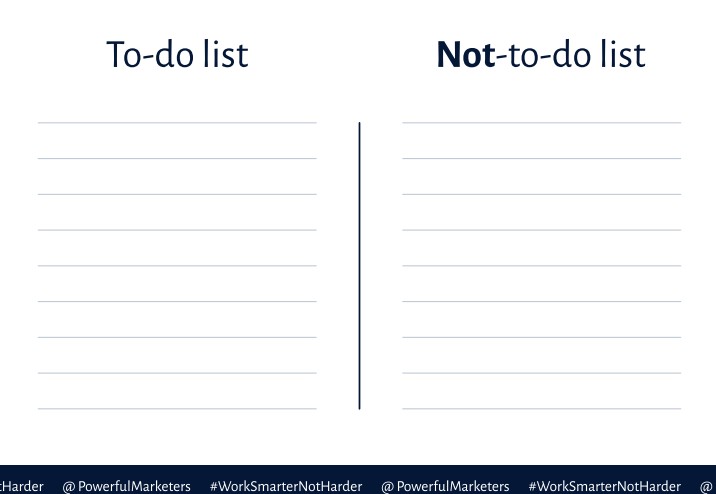
A To-Do tells you what to touch. A Not-To-Do tells you what not to touch while you do it. That second list is the shield. Without it, your best work gets crowded out by pings, meetings, and other people’s priorities.
There is also a mindset shift. When you protect meaningful work from interruption, you finish more of it. Finished work builds trust in yourself and with your team. That trust makes the next round easier because you have evidence that focus pays off.
Write your Not-To-Do first and place it above the To-Do where you can see it. Treat it like the rules of the road.
MIP time: a small daily block that changes each week
MIP stands for Most Important Person. That is you. You cannot control every request that lands in your inbox, but you can protect a short block for your most important work.
How to set it up so it sticks
- Book it on the calendar. Pick the time of day when your energy is highest. Start with 25 minutes. If you have space, extend to 50 or 75 minutes. Stop before your concentration drops.
- Make it visible. Add a short status note. Tell your closest teammates that you will be unavailable during the block and will respond afterward.
- Reset the environment. Close browsers. Silence notifications. Phone on airplane mode. Adjust light and temperature. Have water nearby. Music without lyrics can help some people; silence helps others.
- Use a gentle boundary. A simple desk sign or calendar label is enough. You are not closing the door on your team. You are keeping promises to the work you are responsible for.
Nothing should break MIP time unless it is mission-critical. If a pattern keeps interrupting you, add a rule to your Not-To-Do so it does not repeat.
Grab a free MIP productivity tool.
The weekly To-Do: simple, specific, and small
A long list invites drift. A short list invites action. Build your week around three parts.
1) One Big Rock
Name the single outcome you will deliver by Friday. Write it as a result, not an activity. For example:
- Publish the next quarter’s event landing page and open registration.
- Interview three customers and draft the new case study outline.
- Finalize next month’s content plan, including owners and deadlines.
The Big Rock should connect to real goals, not only to today’s noise. When you choose it well, scattered activity turns into momentum because small tasks are pulling in the same direction.
2) One 25-minute MIP block today
One block is enough to start the rhythm. Protect it. You teach people how to treat your time. If you respond instantly to every ping, you teach the world that you are always available. If you respond after your block, you teach that focused work matters, and you still deliver.
3) Three micro-actions to move the Big Rock
Keep each under five minutes. The aim is to remove friction at the start. Examples:
- Send two time options for the interviews with a booking link.
- Draft three headline options.
- Pull last month’s conversion numbers into one sheet.
Micro-actions get you moving. Once you begin, the next step is easier.
The Not-To-Do: rules that protect energy, time, and standards
You do not need many rules. You need a few that you will actually follow. Start with these and adjust to your role and team.
No multitasking during MIP.
Multitasking reduces quality and speed. Keep tools closed. Phone on airplane mode. Let people know you will reply after the block.
No meetings without an agenda, owner, and outcome.
If there is no clear purpose, ask for an agenda or suggest a shorter huddle. If a decision is not needed, consider an asynchronous update. Meetings should move work forward, not create more of it.
No inbox grazing.
Batch email twice a day. Clear it during lower-energy windows, not during your best hours. If an email arrives during MIP, ask whether it can wait until your planned response time. Most can.
No content scrambling.
Plan once per month. Repurpose with purpose. Keep a simple library of your foundations so you don’t have to start from scratch every time.
No “always on” availability.
Urgent for someone else does not always mean urgent for you. Ask for timing—route requests into planned slots. Protect the hours you rely on for deep work.
No perfect-first-try rule.
Ship a version, learn, and iterate. Your audience notices reliability more than perfection.
A seven-day rhythm you can keep
A good week is not about doing more. It is about doing what matters most, regularly. Try this structure for the next seven days.
Monday: choose the Big Rock.
Write the Friday outcome in one line. Share it with your team so people see the why behind your choices.
Every workday: book one MIP block.
Place it in the calendar. Treat it as a meeting with yourself that you do not miss.
Late morning or afternoon: batch admin.
Clear inbox. Reply to messages. Update tasks. Do this in one or two short windows rather than all day.
End of day: reflect and set up tomorrow.
What moved the Big Rock today? What blocked it? What is the next micro-action? Put it at the top of tomorrow’s list.
Repeat – small, steady moves compound.
How does this help the team, not only you?
Great marketing is a system, not a solo sport. When people align To-Dos and Not-To-Dos across a team, three things happen.
- Less duplication. Work becomes visible. Two people do not build the same asset in different folders.
- Clearer messages. Campaigns support the same promise. Sales, service, and marketing sound like one company.
- More trust. You deliver when you say you will. Stakeholders learn the cadence and begin planning around it.
If you lead a team, try a short Monday stand-up where everyone shares their Big Rock and one risk to watch out for. Keep it to ten minutes. Mid-week, do a quick check-in. On Friday, review what shipped and what you learned. This rhythm keeps attention on outcomes, not only activity.
Planning for 2026: align around the client journey with Sales
Right now, many teams are building 2026 plans. Start by mapping the client journey together with sales. Look at the real path people take: how they find you, what builds trust, what slows deals, and what turns customers into advocates. Then choose work that moves those moments.
Use a blank page. Do not carry “yesterwork” into the new year just because it is something you have always done. Decide with sales what truly matters for 2026 and draw a hard line:
- To-Do: actions that clearly move the client journey with owners, outcomes, and timing.
- Not-To-Do: tasks that do not create value or evidence. Think legacy reports that nobody reads, vanity posts, low-impact events, and random nice-to-have items.
A quick kickoff you can run next week:
- Map the journey together in one hour.
- Mark the two highest-friction moments to fix in Q1.
- Turn every carry-over task into a question: Does this move the journey? If not, add it to the Not-To-Do.
This is how Marketing and Sales enter 2026 on one page with fewer tasks, clearer priorities, and more momentum.
A personal note: if you feel overwhelmed
If your calendar looks like it belongs to someone else, you are not alone. Most marketers live inside other people’s requests. Start with one boundary and one block.
You will be surprised how quickly people adapt when you hold your line kindly and clearly, progress over perfection. Rhythm beats rush.
Copy this and use it today:
To-Do (daily and weekly)
- One Big Rock for the week, written as a Friday outcome.
- One 25-minute MIP block today.
- Three micro-actions under five minutes to move the Big Rock.
Not-To-Do
- No multitasking during MIP.
- No meetings without an agenda, owner, and outcome.
- No inbox grazing. Batch twice a day.
- No reinventing content. Plan once and repurpose with purpose.
- No always-on availability. Ask for timing and schedule.
- No perfect-first-try rule.
These small rules protect your energy. They also strengthen your reputation for clarity and follow-through, which is the foundation of trust in any market.
Come build your rhythm with us → Powerful Marketers Hub
FAQs
Why do marketers need a Not-To-Do list in 2026?
Because marketing overload is no longer a time problem, it’s an attention problem. A Not-To-Do list prevents constant interruptions, unnecessary meetings, inbox grazing, and reactive work. In 2026, marketers who win are not the busiest; they are the most focused.
What is MIP time, and why does it matter for marketing productivity?
MIP time stands for Most Important Person time, a short, non-negotiable block dedicated to deep, strategic work. It matters because marketing progress requires thinking, planning, and decision-making, not just execution. Protecting MIP time ensures your most valuable work actually gets done.
How long should MIP time be?
Start with 25 minutes per day. If your energy allows, you can extend it to 50 or 75 minutes. The goal is consistency, not duration. Even one focused block per day can dramatically improve marketing outcomes over time.
