
Marketing
The 2030 Marketing Skills Matrix: Why Doing the Work Is Free, and What Actually Pays
Generative AI has turned routine marketing production into a zero-cost commodity. Here is how commercial leaders move out of the obsolete zone and govern P&L discipline, trust architecture, and agentic systems.

Mari-Liis Vaher4 min read

Look at the latest World Economic Forum (WEF) future of jobs data, and you will see a quiet shift playing out in black and white.
Sitting in the bottom-left corner (the zone of declining commercial demand) is traditional “marketing and media.”
At the top right are the skills enterprises are aggressively competing for: systems thinking, analytical judgment, leadership, and commercial orchestration.
The market is delivering a verdict that every CEO feels intuitively: paying people simply to produce marketing tasks is coming to an end.
1. The Zero-Dollar Execution Trap
For twenty years, a marketing department justified its existence through output: writing copy, scheduling social posts, setting up landing pages, and sending email blasts.
Today, generative AI tools do all of that in ten seconds for pennies.
When the cost of producing content drops to zero, its commercial value collapses with it. Generating forty blog posts and a hundred automated LinkedIn messages does not build an enterprise. It simply floods the market with synthetic noise.
B2B buyers are not suffering from an information shortage. They are suffering from a trust deficit.
When execution becomes free, execution is no longer an asset. The premium shifts entirely to direction, capital discipline, and human trust.
2. The Four Quadrants of Modern Marketing
If you map today’s commercial activities against business impact and technological capability, the market breaks into four stark zones:
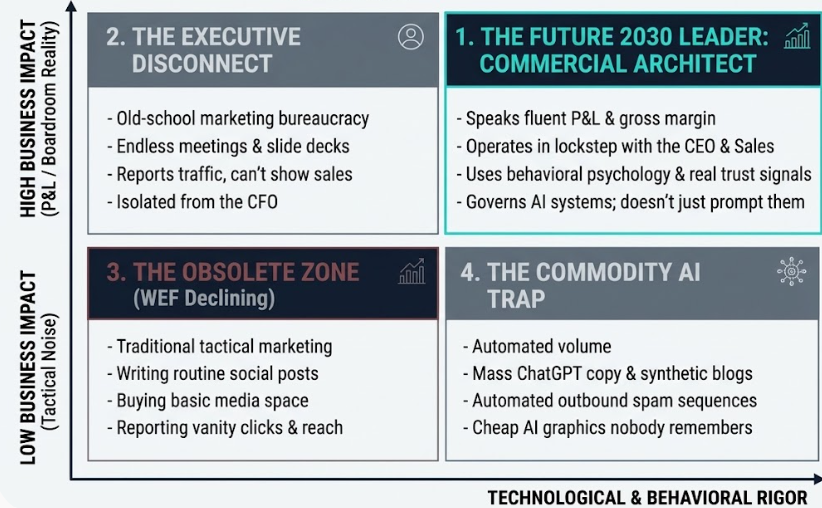
- The Obsolete Zone (Bottom Left): The old-school marketer who reports on impressions, clicks, and brand awareness without financial accountability. This function is being systematically eliminated.
- The Commodity AI Trap (Bottom Right): Using AI just to make more junk faster. Mass-producing generic emails and synthetic blog posts creates operational churn, but burns client goodwill.
- The Executive Disconnect (Top Left): Smart people talking in abstract theories. They understand brand, but they cannot show how their work shortens the sales cycle or protects EBITDA. For this reason alone, over 70% of CEOs do not trust marketing reports.
- The Commercial Architect (Top Right): The strategic leader who aligns company narrative, sales velocity, and board-level financial returns into a single, cohesive operating machine.
3. How Three Master Operators Validate the Shift
This matrix is not abstract theory. It reflects the fundamental operating principles of three thinkers who understood how businesses actually scale:
#1
The market mistake: Marketing teams rush to test 50 new AI apps and create ten times more collateral that nobody wants.
The rule: True skill is subtraction. It means stripping away vanity projects, clarifying the product’s core truth, and focusing the company on three clear, non-negotiable priorities.
#2
The market mistake: Marketing hiding behind creative feelings and operational vanity metrics when revenue targets fall short.
The rule: Commercial teams must operate like business owners. You must understand how your work impacts cash flow, pipeline velocity, and Customer Acquisition Cost (CAC) payback. If you cannot tie your work to commercial health, you are an overhead cost waiting to be cut.
#3
The market mistake: Assuming data and algorithms alone will convince enterprise buyers.
The rule: Because AI makes everything look smooth, logical, and identical, genuine differentiation comes from human trust. You prove credibility through real skin in the game: legally protected IP, formal accreditations, and long-term commitments that an automated bot cannot fake.
4. The Five Core Pillars of the Future-Proof Commercial Leader
To move from tactical noise to enterprise leadership, commercial operators must master five specific disciplines:
01
Executive Tandem Alignment
The ability to sit between the CEO, sales leadership, and product teams to forge a single, shared commercial thesis.
02
Costly Signaling & Trust Architecture
Designing brand proof points—registered trademarks, audited methodologies, published books—that prove operational permanence.
03
P&L Financial Governance
Anchoring every commercial initiative directly to pipeline velocity, deal size, and gross margin contribution.
04
90-Day Execution Cadence
Replacing vague annual marketing plans with disciplined, quarterly execution cycles that deliver measurable outcomes.
05
Agentic System Orchestration
Leading technology as an architect—designing intelligent workflows and analyzing data models—rather than wasting hours writing routine text by hand.
Machines have taken over tactical production. Strategic judgment, commercial discipline, and institutional trust belong in the boardroom.
The marketers who learn to govern these fundamentals do not get automated away. They become the CEO’s most valuable commercial partner.
Key Reference Sources
- World Economic Forum (WEF): Future of Jobs Report (Decline of conventional media/marketing vs. high demand for analytical thinking, systems thinking, and leadership).
- McKinsey & Company: The Growth Engine (CEO perspectives on marketing accountability and commercial integration).
- Gartner: CMO Spend and Strategy Surveys (Shifts from tactical channel budgets to pipeline velocity and commercial governance).